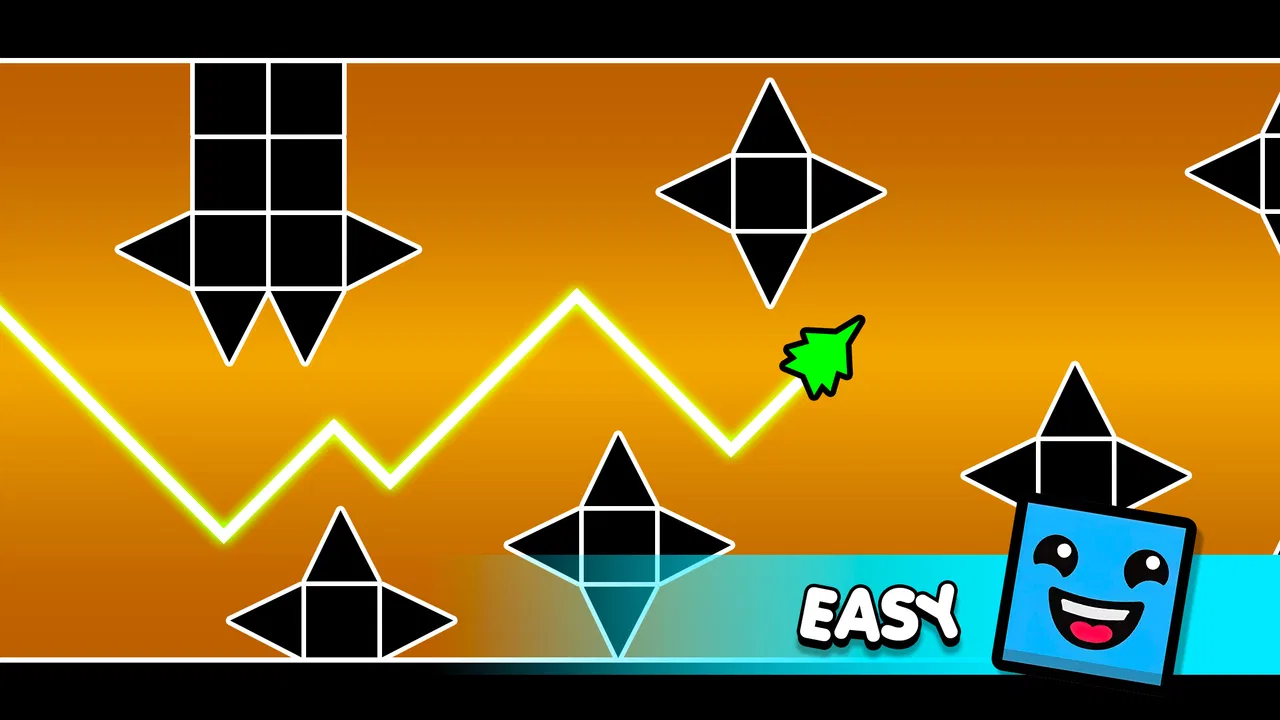
Geometry Vibes
- 3.6
- Rating
- 1.00M
- Installs
- Free
- Price

 Analysis by App-foxy
Geometry Vibes is the kind of arcade game I can open for a quick burst and understand almost immediately. The idea is simple: guide your movement, react to incoming obstacles, and stay alive for as long as your attention and timing allow. That simplicity is its strongest invitation, but it also creates the central question I kept asking while playing: does avoiding the next obstacle remain satisfying once the first few attempts stop feeling new?
My answer is cautiously positive. The gameVgames release has a clean, reaction-first identity that works well for short sessions, especially when I want something more active than a passive time-killer. It is free, rated for Everyone, and belongs squarely in the arcade category. With a 3.4 average from around 1.7 thousand ratings and more than one million installs, it has clearly reached a sizeable audience, although that rating also suggests the straightforward concept will not suit every player.
How the first goals shape the experience
The opening objective is easy to understand without a tutorial-heavy approach: keep moving and avoid what is in your path. That immediate clarity matters on a phone. I did not need to learn a long ruleset before making my first attempt, and the game’s reaction-based design makes the first goal feel physical rather than administrative. I am not managing a complicated inventory or reading through layers of menus; I am watching the play area and trying to respond correctly.
You May Also Like

 Blood Strike: 2.5 Anniversary
Blood Strike’s Loadouts Turn Every Drop Into a Tactical Gamble
A close look at Blood Strike’s custom loadouts: how fast access to signature weapons reshapes its battle royale rhythm, rewards preparation, and narrows the gap between fights.

 Pandora - Music & Podcasts
Pandora’s Music Is Easy to Start, but Harder to Recover
Pandora’s strength is its low-effort path from a seed to a station. Its weak spot is how much confidence it asks you to place in connection, setup, and quiet recovery.

 8 Ball Pool
 Is Built on Rivalries, Rematches, and Routine
A close look at the rivalries, rematches, shared routines, and unanswered safety questions that turn a quick pool match into a persistent mobile community.

 Samsung Music
’s Quiet Strength Is Playing What You Already Own
Its reach comes less from spectacle than from dependable access to a personal library. That simplicity is both the app’s strongest retention engine and its ceiling.

 AccuWeather: Weather Radar
AccuWeather Review: A Quick, Clear Forecast for Everyday Decisions
For everyday plans, the best forecast is the one you can understand quickly. AccuWeather makes rain timing, radar, and local conditions easy to act on, with a few trade-offs.

 Hill Climb Racing
Why Hill Climb Racing Still Turns Crashes Into One More Run
A tiny car, a bumpy hill and one more upgrade: Hill Climb Racing keeps resurfacing because its simple chaos makes every near-miss feel personal.
More From Our News Desk



That gives the early minutes a useful rhythm. A successful dodge feels like a small personal achievement, while a mistake points directly to the problem: I reacted too late, moved too far, or failed to read the obstacle in time. In many arcade games, the first objective is little more than “play until something happens.” Here, survival itself is the immediate test, so even a short run has a clear purpose.
The trade-off is that the game’s early goal is narrow. Players who enjoy mastering one repeated action can settle into it quickly, but anyone looking for a story, a broad set of missions, or a long list of changing objectives may feel that the invitation is thin. I would not choose this as my main game if I wanted a sense of exploration. I would choose it when the appeal is improving a reaction and trying to make the next attempt cleaner than the previous one.
A realistic use case is a short waiting period: I can start a run while waiting for a coffee, play through a few attempts, and stop without needing to remember a complicated plot or rebuild a strategy. The game’s basic premise supports that kind of interruption-friendly play. It asks for attention during the attempt, but it does not appear to demand a long commitment before the fun starts.
What counts as progress when survival is the goal?
Geometry Vibes is more about personal progress than a broad progression journey. The clearest signal is how consistently I can avoid obstacles and how far I can push a run before losing control. That makes improvement easy to feel, even if it is not presented as a conventional character-building system. My progress is visible in my own performance: fewer careless collisions, better anticipation, and a stronger sense of when to commit to movement.
This kind of design can be surprisingly motivating because it removes excuses. If I fail, I can usually connect the result to a moment in the run rather than blaming an unclear objective. The best way to improve is not to rush into another attempt immediately, but to identify the point where my attention broke down. Was I watching the next obstacle while ignoring the current path? Did I make a correction that was too large? Did I react to danger only after it was already unavoidable?
That leads to one practical tip: I found it more useful to treat each attempt as a short experiment instead of simply chasing a better result. On one run, I might focus on making smaller movements. On another, I might concentrate on looking farther ahead. This turns repetition into deliberate practice and gives the simple obstacle-avoidance loop more depth than it has at first glance.
There is also a psychological limit to this form of progress. If a player needs visible unlocks, collectible goals, or a growing set of systems to stay interested, personal improvement may not be enough. The game’s appeal depends heavily on whether the player enjoys refining timing for its own sake. That is an important distinction from arcade alternatives built around unlockable characters, themed stages, or a steady stream of new objectives.
Reading the difficulty curve instead of blaming reflexes
The challenge works best when I approach it as a reading problem, not merely a test of fast fingers. Avoiding obstacles requires me to process position, timing, and the likely consequence of a movement. A rushed response can be worse than a slightly delayed but controlled one. That is why the game can feel demanding even though the rule is simple: the number of decisions may be small, but each decision matters.
I also noticed that difficulty in a reaction game is felt through pressure rather than through a complicated ruleset. As a run continues, concentration becomes part of the challenge. A movement that seems obvious at the beginning can become harder after several successful dodges because I am trying not to throw away progress. The longer I last, the more tempting it is to make a panicked correction.
My most useful adjustment was to avoid playing with a “save the run at all costs” mindset. That attitude made me overcorrect whenever an obstacle appeared. A calmer approach worked better: observe the available space, choose the smallest response that keeps the path safe, and accept that not every situation can be repaired. This is a non-obvious strength of the design. The game rewards composure as much as raw reaction speed, at least for players willing to learn from their mistakes.
Still, reaction-based difficulty has a narrow comfort zone. If controls feel too sensitive for a particular player, the experience can become frustrating rather than motivating. Younger players may enjoy the immediate challenge, helped by the Everyone content rating, but that rating does not mean the game will be equally comfortable for every age or reflex level. Someone who prefers relaxed puzzle solving should probably look elsewhere.
The game also asks for a particular kind of attention. It is not ideal when I am distracted by conversation, notifications, or a noisy environment. A player may technically have a few spare minutes but still not have the focus needed for a good attempt. That makes it different from slower arcade games that can be played while multitasking. Here, the short session is convenient, but the moment-to-moment concentration is real.
Does the pacing create enough pressure to keep returning?
The pacing is built around the tension between a quick restart and the desire to improve. Because the central action is easy to grasp, returning to the game does not require preparation. I can fail, understand roughly why, and try again while the mistake is still fresh. That loop is valuable in an arcade title: the gap between failure and another attempt should feel small enough that curiosity wins over irritation.
For me, the strongest retention pressure comes from unfinished personal business. If I lose after a promising sequence, I want to see whether I can handle that same level of concentration better next time. This is not the same as being pulled through a narrative or toward a collection. It is the familiar arcade urge to beat my own previous performance, and it works best when I am in the mood for repetition.
The weakness is equally clear. A game based on one core activity can reach a point where the pressure stops feeling fresh. If every return is only another attempt to avoid obstacles for longer, players who need new scenery or new mechanics may run out of reasons to continue. I would not describe that as a flaw in execution so much as a limitation of the chosen format. The design is focused, and focus always means leaving some tastes unserved.
One way I would use it is as a deliberate reset between demanding tasks. Rather than playing endlessly, I would set myself a small personal target, such as completing a run with fewer impulsive movements or staying composed through a difficult sequence. Then I would stop once the session becomes repetitive. That keeps the game’s pressure useful instead of allowing it to turn into frustrated, automatic retries.
It is also worth being realistic about the social side of the experience. A personal score-chasing loop can be compelling even without a large feature set, but it is less naturally engaging for people who want cooperative play or direct competition with friends. If shared sessions are the main reason I play arcade games, a title designed around multiplayer interaction would be a better choice. Geometry Vibes is more suited to an individual contest against my own timing.
What the current release means for new players
The game is currently at version 1.7 and supports devices running Android 8.0 or later. That makes the practical entry point fairly clear for Android users: check the operating system before installing, then expect a compact arcade experience rather than a large multi-mode package. The developer is gameVgames, and the free price removes the need to make a purchase decision before discovering whether the reaction loop fits.
Free access is especially helpful here because the game’s appeal is personal. Some players will immediately enjoy the directness, while others will find the repetition too limited. Being able to try it without paying makes that difference easier to judge for yourself. I would still approach the first session with the right expectation: the value is in the act of playing and improving, not in uncovering a deep collection of content.
The Everyone rating also makes it an easy recommendation for a broad audience from a content standpoint. My more important qualification is about temperament. I would suggest it to someone who likes quick arcade challenges, visible improvement, and the satisfaction of surviving a little longer. I would skip it for a player who wants a relaxing pace, a story-driven campaign, extensive customization, or a progression system that constantly opens new activities.
How it compares with familiar arcade alternatives
Compared with endless runners, Geometry Vibes feels more concentrated around reaction and obstacle reading. Endless runners often add lanes, collectibles, boosts, or environmental variation to keep the run moving. Here, the attraction is more stripped back: I am not playing to gather a large set of items or follow a character through a themed journey. I am playing to respond correctly and preserve the run.
That focus can be an advantage when I want a clean test without distractions. It also means the game has less to offer if I measure variety by the number of systems on screen. Against puzzle arcades, it is less about planning several moves ahead and more about handling immediate danger. Against casual tap games, it demands more sustained visual attention and gives mistakes a sharper consequence.
The best alternative depends on what I want from the category. If I want a quick personal challenge that starts instantly, this is a sensible pick. If I want collecting, narrative context, social play, or a broad progression map, another arcade game will probably hold my interest longer. I would not call Geometry Vibes a universal replacement for those experiences; I see it as a focused option for a particular mood.
That comparison also explains the average rating of 3.4. A score in that range does not tell me that the game is unusable, but it does fit the experience I had: the core idea is accessible and potentially satisfying, while the limited scope can divide players. People who value simplicity may appreciate the restraint. People who expect a fuller package may judge it more harshly.
My progression verdict after weighing goals, challenge, and pacing
Geometry Vibes succeeds when its narrow objective matches what I want. The early goal is immediate, the progress signal comes from better survival, and the difficulty encourages me to replace panic with controlled reactions. Its retention comes from the urge to improve rather than from a large chain of unlocks or changing activities. That can create a strong personal loop, but only for as long as I enjoy practicing the same fundamental skill.
I would recommend it to a friend who likes arcade games that respect their time and get to the point. It is particularly suitable for short breaks, repeated attempts, and players who enjoy measuring improvement through cleaner decisions. The free price and Everyone rating make it approachable, while the Android 8.0 minimum gives compatible users a straightforward way to try it.
I would give a different recommendation to someone seeking a long-term game with rich progression. The reaction-based structure does not provide the same kind of journey as an arcade title filled with unlocks, missions, or changing modes. Its pacing can feel compelling during a focused session, then repetitive once the personal challenge stops feeling fresh. Knowing that before installing is more useful than treating the game as something it was never designed to be.
My final view is that Geometry Vibes is best understood as a focused reflex workout, not a content-heavy arcade adventure. When I play it with a small goal and pay attention to how I move, the simplicity becomes the point rather than a missing feature. When I want variety or a deeper progression path, I would choose another game. For the right player, though, the next obstacle is enough to create one more attempt.
FAQs for Geometry Vibes
01What is Geometry Vibes, and what makes it unique?
Geometry Vibes is an engaging rhythm-based platformer game where players navigate geometric shapes through various levels set to vibrant music. Its unique blend of fast-paced gameplay, synchronized music, and colorful visuals sets it apart from other platformers, providing a thrilling challenge for players who enjoy rhythm and precision.
02Is Geometry Vibes suitable for all ages?
Yes, Geometry Vibes is designed for players of all ages. Its intuitive controls and progressive difficulty make it accessible for younger players, while the challenging levels and dynamic music tracks offer enough complexity to keep older players engaged. Parents can rest assured that it’s a safe and entertaining choice.
03Does Geometry Vibes require an internet connection to play?
Geometry Vibes can be played offline, which makes it perfect for gaming on the go without worrying about data usage. However, an internet connection is required to access certain features, such as leaderboard updates and downloading new music tracks or levels, enhancing the overall experience.
04Are there in-app purchases in Geometry Vibes?
Yes, Geometry Vibes offers in-app purchases. Players can buy additional levels, skins, and music tracks to enhance their gameplay experience. While these purchases can enrich the game, they are optional, and players can still enjoy the core experience without spending extra money.
05How does Geometry Vibes handle updates and new content?
Geometry Vibes frequently releases updates that include new levels, music tracks, and features. The developers are committed to keeping the game fresh and engaging, responding to player feedback and ensuring a vibrant community. Regular updates ensure that players always have something new to explore and enjoy.
Pros
- Visually captivating geometric design.
- Smooth
- intuitive controls enhance gameplay.
- Wide variety of challenging levels.
- Regular updates with new features.
- Offline mode available.
Cons
- In-app purchases can be costly.
- Ads can be frequent and intrusive.
- Occasional performance lags on older devices.
- Limited soundtrack variety.
- Requires significant storage space.

Geometry Vibes
Gallery